

Tree Fell on a Power Line: Who Is Responsible?
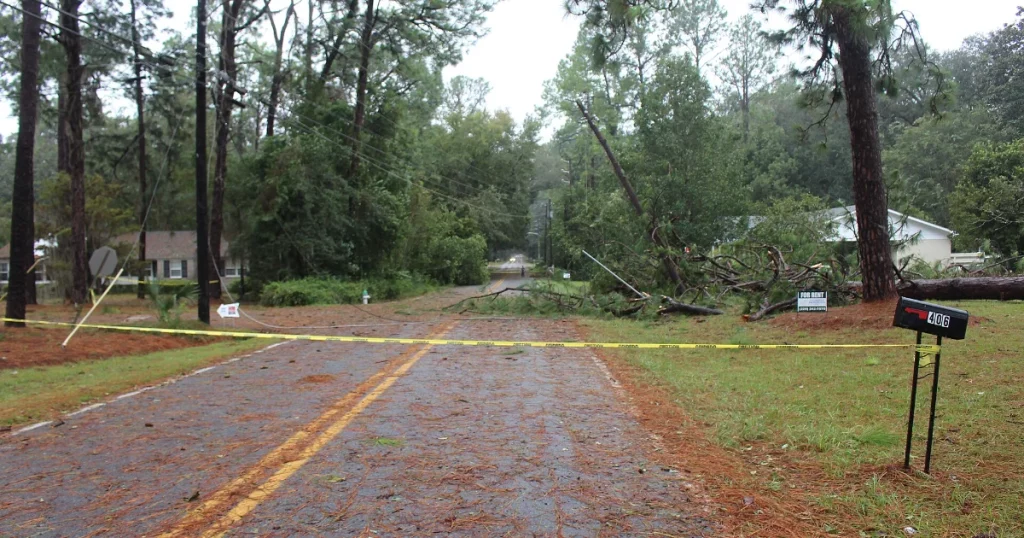
The storm passes, you walk outside, and a limb from the oak is lying across the wires. Or worse — the wire that used to run from the pole to your roof is now draped over the driveway, and the lights are out.
Two questions arrive immediately: who fixes this, and who pays for it? The answers are genuinely confusing, because the honest answer to “who owns that wire?” is it depends on which wire you’re looking at — and most of the advice online picks one rule and states it as gospel. Several of the most-read pages on this topic flatly contradict each other. Here is how it actually breaks down.
Who is responsible when a tree falls on a power line?
The utility is responsible for repairing its own lines and equipment, and it will cut the tree off the wires to restore service — but it generally will not haul the debris away, and it will not repair the equipment attached to your house. Who pays for the tree itself usually turns on whether it was healthy. A healthy tree brought down by a storm is typically treated as an act of nature; a tree the owner knew was dead or hazardous can shift liability to that owner.
That is the short version. The details are where the bills hide.
Before anything else: treat every downed line as live
Nothing in this article matters more than this section. A downed conductor can remain energized, can re-energize without warning as crews work, and can charge the ground and any fence, puddle, or vehicle touching it. People are killed every year approaching wires that looked dead.
The 60-second checklist
- Assume the line is live. No exceptions, no matter how still it is.
- Stay far back and keep everyone — children, pets, curious neighbors — away.
- Call 911 and your utility. Both. In that order if there’s fire or injury.
- Do not touch anything the line is touching — the tree, a fence, a car, a puddle.
- If you’re in a vehicle that’s in contact with a line, stay in it until crews say otherwise.
- Do not try to move the tree, even on your own property, even with a wooden handle. Wet wood conducts.
- Leave tripped breakers off until the situation is cleared.
The 10-foot rule is a safety distance, not an ownership line
You will see “10 feet” and “15 feet” quoted online as if they define where the utility’s responsibility ends. They don’t, and this is worth correcting because the confusion is genuinely dangerous.
Ten feet is a worker safety distance. Under OSHA’s rules, people who are not electrically qualified must stay at least 10 feet away from overhead lines. Line-clearance tree trimmers are a specially trained and qualified category precisely because their work happens inside that distance. It has nothing to do with who owns what.
The practical takeaway is the opposite of a loophole: if any part of a tree is within about 10 feet of a power line, that is not a homeowner job or a general tree service job. It requires a line-clearance qualified professional, and often a call to the utility to de-energize first — which many utilities will do at no charge so a crew can work safely.
Which line fell? Three lines, three owners
Almost all of the confusion on this topic dissolves once you can identify what you’re looking at.
How to tell them apart
- Transmission lines — the long-haul, high-voltage lines on tall steel towers or lattice structures, running cross-country. Entirely the utility’s, and vegetation near them is managed under strict federal reliability standards.
- Primary distribution lines — the thick wires strung at the top of the wooden poles along your street or through backyard easements. Utility-owned, utility-maintained, utility-trimmed.
- The service drop — the thinner, usually twisted or bundled set of wires running from the pole to a bracket on your house. This is the one that falls on driveways, and it is the source of nearly all the disagreement.
Utilities are required to keep vegetation clear of their lines through a combination of national safety standards, federal reliability rules for transmission, and state vegetation-management plans filed with the public utility commission. But that duty runs to their lines — pole to pole. Keeping vegetation clear of the service drop to your house generally falls on you. That single fact catches most homeowners off guard.
One quirk worth knowing: the pole itself may not belong to the electric company. Poles are often jointly used, and the owner can be the telephone or cable provider. If a pole is damaged, “call the power company” may not be the whole answer.
The demarcation point — the part that never varies
Here is the resolution to the contradiction you’ll find everywhere online. Ownership of the service drop wire itself varies by utility. Some utilities own and repair it outright; others will re-attach it if a storm tears it loose. So the correct answer to “who owns the drop?” is genuinely “check your provider.”
But there is a part that doesn’t vary, and it is the part that costs you money. Everything from the point of attachment inward is the customer’s. Two utilities on opposite sides of the country say the same thing: Con Edison owns and repairs the service wire from the street and owns the meter, while the service bracket, weatherhead, entrance cable, and meter pan are the customer’s. Duquesne Light draws the line the same way.
| Component | What it is | Typically whose? |
|---|---|---|
| Transmission & primary distribution lines | Tower lines; the thick wires atop the poles | Utility |
| Service drop wire | Pole-to-house wires | Varies by utility — many own or re-attach it |
| Point of attachment / service bracket | Where the drop bolts to your house | Customer |
| Weatherhead & service mast | The hooked fitting and pipe at the roofline | Customer |
| Service entrance cable | Cable down the wall to the meter | Customer |
| Meter | The measuring device itself | Utility (commonly) |
| Meter base / socket / pan | The box the meter plugs into | Customer |
| Service panel & everything inward | Breaker box and house wiring | Customer |
Memorize the pattern rather than the parts: the wire in the air may be theirs; the hardware bolted to your house is yours.
Who pays for what
Two variables decide almost every case: which line or equipment was damaged, and why the tree fell. Most articles answer one axis and leave you stuck. Here are both.
| Damaged | Healthy tree, storm | Owner’s known-hazard tree | You cut it yourself |
|---|---|---|---|
| Utility lines & equipment | Utility repairs, absorbs cost | Utility repairs; may seek costs from the tree owner | Utility repairs; likely bills you |
| Service drop wire | Utility repairs or re-attaches (varies) | Usually still repaired; costs may be pursued | Likely billed to you |
| Your weatherhead, mast, meter base, panel | You — licensed electrician required | You | You |
| Tree debris on the ground | Property owner | Property owner | You |
| Damage to a house or structure | Owner’s insurance, regardless of whose tree | Owner’s insurance; insurer may subrogate | Your liability coverage may respond |
The debris rule nobody expects
This is the single most common unpleasant surprise, and it is nearly universal. The utility’s job is to restore power, not to do your yard work. A crew will cut the tree off the line, clear what’s in the way, and leave. The trunk, the limbs, and the mess on your lawn are yours to deal with, at your expense. As the Office of the Ohio Consumers’ Counsel puts it plainly, trees are considered the homeowner’s property, so consumers may have to arrange debris removal at their own cost. Utilities across the country say the same in their own service terms.
Budget for it. Emergency and post-storm removal commands a premium, and costs vary widely by tree size, access, and how much of the region is competing for the same crews.
If you dropped the tree yourself
Different situation entirely. If you fell a tree into a line, you can be on the hook for the utility’s repair costs — and potentially for the broader consequences of the outage you caused. This is a meaningful financial risk, and it is the strongest argument for the rule above: near lines, hire a line-clearance qualified professional. Verify the credential; don’t take a business card’s word for it.
Negligence vs. act of God
The “knew or should have known” standard
Liability for a falling tree generally does not turn on where the tree grew or where it landed. It turns on fault.
A healthy tree blown down by a storm is typically treated as an act of nature. No one was negligent; the weather happened. The general rule in that case is that the owner of the property where the tree lands deals with it, and their insurance responds.
The exception is where the money moves. If the tree was dead, diseased, visibly leaning, or otherwise obviously hazardous, and the owner knew or reasonably should have known, that owner may be liable for the resulting damage. The legal standard varies by state, but the theme is constant: nature is an excuse, neglect is not. We cover the storm scenario in depth in are you liable for a tree that falls during a storm.
Notice in writing changes everything
“Should have known” is the hinge, and you can move it. If a neighbor’s tree is visibly dying and leaning toward the lines, a dated written notice — a letter or email, with photos, keeping a copy — converts a question about what they should have noticed into a documented fact about what they did know. That single piece of paper is frequently what decides these disputes.
A professional tree risk assessment from an ISA Certified Arborist is the strongest version of the same move, and it cuts both ways: if you own the tree, an assessment showing it was sound is excellent evidence that you were not negligent.
What insurance actually covers
The standard homeowners policy
According to the Insurance Information Institute:
| Situation | Typical treatment |
|---|---|
| A tree hits your house | Covered for wind, lightning, or hail — regardless of who owned the tree |
| Debris removal | Covered only if the tree struck an insured structure; commonly capped around $500–$1,000 |
| Tree fell but hit nothing | Generally not covered — cleanup is out of pocket |
| Your own trees and shrubs | Often about 5% of the dwelling limit, with a per-plant cap |
| Tree fell from poor maintenance | Not covered |
| Neighbor’s tree, their negligence | Your insurer may pay, then subrogate — potentially recovering your deductible |
| Tree hits your car | Comprehensive auto coverage, not homeowners |
Two lines in that table cause most of the anger. “Fell but hit nothing” means a healthy tree that misses the house and lands on your lawn is usually a bill you pay yourself. And the debris sublimit means a $2,000 removal on a covered claim may only see a few hundred dollars of it. See insurance claim for a fallen tree for the filing process, and photograph everything before cleanup.
Outage losses and why you probably can’t recover them
The spoiled refrigerator, the lost work-from-home day, the hotel night — homeowners routinely assume the utility owes them. Usually it does not. Utility service is governed by tariffs approved by the state public utility commission, and those tariffs generally limit the utility’s liability for outage consequences outside its control. A storm is squarely outside its control. Some homeowners policies cover food spoilage under certain conditions; your utility is rarely the answer.
The reconnection trap
Here is the practical trap that no ranking article explains, and it is the one that leaves people dark for days after the neighborhood lights come back on.
When a tree rips the service drop off your house, it usually takes hardware with it — the weatherhead, the mast, sometimes the meter base. Those are yours. The utility can restring its wire, but it generally cannot and will not reconnect to broken customer equipment. So the sequence becomes: you hire a licensed electrician, the repair often has to pass a local inspection, and only then does the utility reconnect. You pay for that, and you wait for it — while your neighbors, whose masts are intact, are already back on. Con Edison and Duquesne Light both spell this out; Con Edison notes it may attempt a temporary restoration in the meantime.
If your power is out and the wire is off the wall, call an electrician immediately — the same hour you call the utility. After a big storm, electricians book out fast, and the queue is what determines when you get power back.
Frequently asked questions
Who pays when a tree falls on a power line?
The utility repairs its own lines and equipment and does not usually bill the homeowner when a healthy tree comes down in a storm. The property owner pays for debris removal and for any damaged equipment attached to the house. If the tree was a known hazard, or if you cut it into the line, costs can be pushed back onto the tree’s owner.
What if I cut a tree and it falls on a power line?
You may be responsible for the utility’s repair costs and for consequences of the outage. This is why any tree within roughly 10 feet of a line should only be worked by a line-clearance qualified professional, often after the utility de-energizes the line — a service many provide free of charge.
Who is responsible for trees next to power lines?
The utility manages vegetation around its own pole-to-pole lines under safety standards and state-approved vegetation-management plans, and holds an easement letting it enter your property to do so. Vegetation around the service drop to your house is generally the homeowner’s responsibility.
How long does it take to fix a power line a tree fell on?
A single isolated service drop can often be restored within hours to a day once crews reach it. After a widespread storm, restoration is triaged — transmission and substations first, then main distribution lines serving the most customers, then individual service drops last. If your own weatherhead or mast is damaged, add the time to get an electrician and an inspection, since the utility cannot reconnect until that’s done.
What happens if a tree on my property falls on power lines?
Call 911 and the utility, and keep everyone away. The utility will clear its lines and restore service. If the tree was healthy and a storm took it down, you generally won’t be billed for the line repair — but you will own the cleanup. If the tree was visibly dead or hazardous, your exposure is greater.
Will the power company cut down a tree near my line for free?
They will trim or remove vegetation threatening their lines as part of routine maintenance, on their own schedule and to their own specification — which is clearance work, not landscaping, and the results are sometimes unlovely. They generally won’t remove a whole tree for aesthetics, and they won’t haul debris. See can a utility company cut my trees without permission.
A power line was pulled off my house — who pays?
Split the question at the wall. The wire from the pole is often the utility’s to re-attach, depending on the provider. The bracket, weatherhead, mast, entrance cable, and meter base are yours, and you’ll pay an electrician to repair them before service is restored. A homeowners claim may respond if a covered peril caused the damage.
Who do I call when a tree falls on a power line?
911 first if there is any fire, injury, or a line across a road, then your electric utility’s outage line. Don’t call a tree service first — they generally cannot legally touch it until the line is de-energized or cleared.
The bottom line
The confusion around this question exists because people are trying to find one rule for three different wires. Identify what fell, and the answers fall out: the utility handles its own lines and leaves your debris, the hardware on your house is yours and needs an electrician before reconnection, and fault turns on whether the tree was healthy or a known hazard.
The best moment to deal with any of this was before the storm. If a tree near your lines is dead, leaning, or dropping limbs, an assessment now is far cheaper than the alternative. Related reading: tree branches touching power lines and who is responsible for removing a fallen tree.
Disclaimer: This article is general information, not legal, insurance, or electrical advice. Utility ownership boundaries, tariffs, and liability rules vary by provider and by state, and policy terms vary by contract. Never approach a downed power line. Consult your utility, your insurer, and a licensed professional about your specific situation.
