

Who Is Responsible for Removing a Fallen Tree?
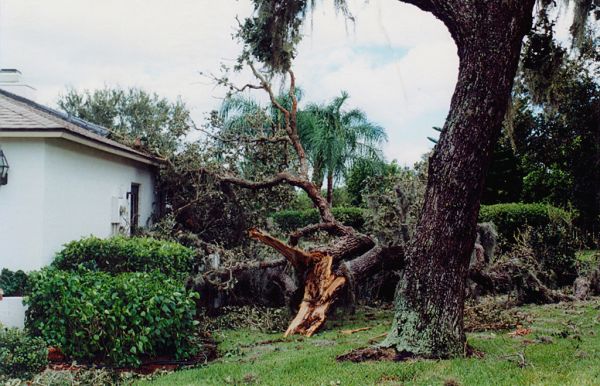
After a tree comes down, two separate bills appear: repairing what it damaged, and hauling away the tree itself. People assume the same person pays both. They usually don’t.
Insurance often plays a role here too: see whether homeowners insurance covers tree removal.
As a general rule, you are responsible for removing the part of a fallen tree that lands on your property — even if the tree grew in your neighbor’s yard. Cleanup follows the land it falls on, just like damage follows the property it hits. Your neighbor only owes removal costs if the tree was a known hazard they negligently ignored.
Here’s how removal responsibility, insurance, and cost-splitting actually work.
The “where it lands” rule for removal
Courts and insurers treat a fallen tree as the problem of whoever’s land it’s now sitting on. If your neighbor’s maple topples and the trunk lands across both yards, each of you is generally responsible for clearing the portion on your own side. This mirrors how liability works when a neighbor’s tree falls on your house.
| Where the tree lands | Who clears it | Who typically pays |
|---|---|---|
| Entirely on your property | You | You (or your insurer if it hit a structure) |
| Across both yards | Each clears their side | Each owner for their portion |
| Still on the neighbor’s property | Neighbor | Neighbor |
| Dead tree neighbor was warned about | You clear, then seek reimbursement | Negligent neighbor may owe costs |
When does insurance cover removal?
Homeowners insurance usually pays for tree removal only when the fallen tree damages a covered structure — your house, garage, fence, or it blocks a driveway or ramp for the disabled. A tree that falls harmlessly in your yard is typically your own cost to haul away.
Typical coverage limits
Even when removal is covered, policies often cap it (commonly a few hundred to around $1,000 per occurrence). Read your policy or see what homeowners insurance covers for fallen trees and how to file the claim.
Getting a negligent neighbor to pay removal
If the tree was visibly dead, diseased, or leaning and your neighbor ignored warnings, you may recover removal costs from them. You’ll need the same proof used in any negligence case: photos of decay, an arborist’s statement, and evidence the neighbor had prior notice. Then send a demand letter, and if they refuse, consider small claims court.
Splitting removal costs fairly
When a tree straddles the property line (a “boundary tree”) or neither side was negligent, the practical and neighborly solution is to split the cost. Get two or three written quotes, agree in writing on the share, and hire one company to do the whole job — it’s cheaper than two separate crews.
- Confirm ownership first — see who owns a tree on the property line.
- Get itemized quotes so removal, stump grinding, and hauling are clear.
- Put the cost-share agreement in a short signed note to avoid later disputes.
Step-by-step after a tree falls
- Check for downed power lines and call the utility before touching anything near them.
- Photograph the tree and any damage before removal.
- If it hit a structure, file with your insurer and ask whether removal is included.
- If the tree was a known hazard from next door, notify the neighbor in writing.
- Get written removal quotes; agree on cost-splitting where appropriate.
Frequently asked questions
My neighbor’s tree fell in my yard but didn’t hit anything. Who removes it?
Generally you do, at your own cost, unless the tree was a hazard the neighbor was warned about.
Does insurance pay to remove a tree that didn’t hit my house?
Usually not. Most policies only cover removal when the tree damages a covered structure or blocks essential access.
Who pays to grind the stump?
Stump removal is rarely covered by insurance and typically falls to the property owner; for a boundary tree, split it.
Can I throw the branches back over the fence?
No — dumping debris onto a neighbor’s land can create its own liability. Dispose of it properly or split a haul-away.
For the claims process itself, see how to file an insurance claim for a fallen tree.
Disclaimer: General information only, not legal or insurance advice. Coverage and liability vary by state and policy; consult your insurer or a licensed attorney. Consumer insurance basics: Insurance Information Institute.
