

Constructive Notice in Tree Law: When a Neighbor “Knew”
Constructive notice means a tree owner is treated by the law as having known about a hazardous tree because the defect was obvious enough that a reasonable person inspecting the property would have seen it — even if nobody ever told them. It is the doctrine that stops “I never noticed” from being a defense, and it is usually the deciding issue when a falling tree causes damage.
Almost every contested tree case turns on one question: did the owner know? Liability for a fallen tree is not automatic. A landowner is not an insurer of their trees; they are liable only if they failed to exercise reasonable care about a danger they knew or should have known about. Constructive notice is the “should have known” half of that sentence, and understanding how courts apply it tells you exactly what evidence wins these cases.
The two kinds of notice
Courts distinguish between actual and constructive notice. Both do the same legal work — they establish that the owner’s duty to act was triggered — but they are proved very differently.
| Actual notice | Constructive notice | |
|---|---|---|
| Definition | The owner was in fact informed of the defect | The defect was apparent enough that a reasonable owner would have discovered it |
| Typical proof | Certified letter, texts, emails, arborist report handed over, municipal citation, recorded conversation | Dated photographs, duration of the condition, testimony from neighbors, the tree’s visibility from the home |
| Strength | Very strong; hard to rebut | Strong but arguable; depends on obviousness and time |
| Owner’s counter | “I received it but the tree looked fine” / “I acted reasonably quickly” | “The defect was internal and invisible” / “It only appeared recently” |
Why constructive notice exists
Without it, the least attentive property owner would be the least liable — a perverse result. The doctrine sets a floor: you are responsible for the condition of your land as a reasonably observant owner would perceive it. You cannot avoid a duty by declining to look.
What constructive notice is not
It is not strict liability. A tree that fails from internal decay with no external symptom — no cavity, no conks, no dieback, no lean — generally does not put its owner on notice, and the resulting loss is usually treated as an act of God. Nor does it require homeowners to commission professional inspections on a schedule. The question is always what was reasonably visible, not what a laboratory would have found.
What courts treat as an obvious defect
Judges and juries look for conditions a layperson could see and understand. The clearer and longer-lasting the sign, the stronger the constructive-notice argument.
Visible signs that establish notice
| Condition | Why it signals danger | Notice value |
|---|---|---|
| No foliage during the growing season | The clearest possible sign the tree is dead | Very high |
| Large mushrooms or hard conks at the base or on the trunk | Fruiting bodies of decay fungi; indicates advanced internal rot | High |
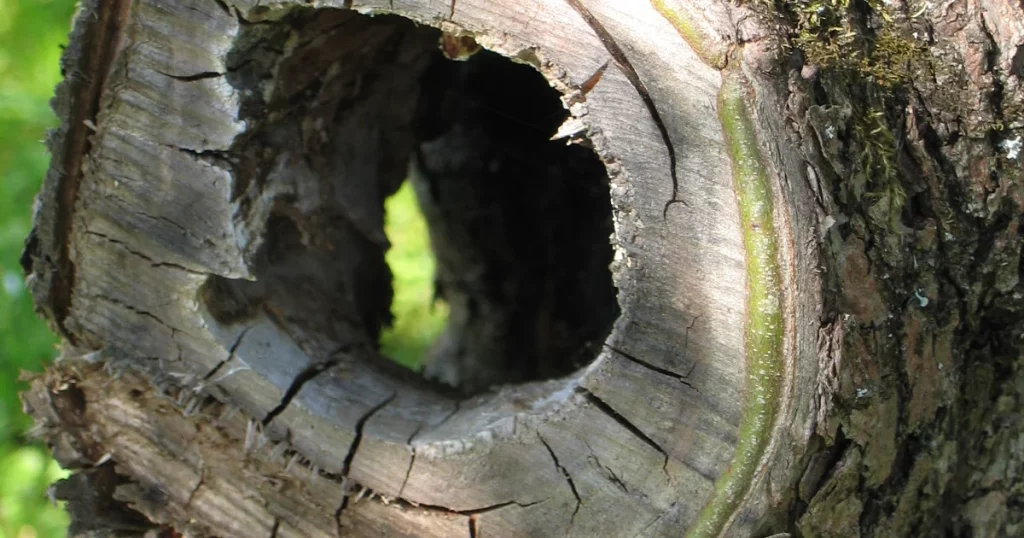
| Open cavity or hollow in the trunk | Reduced structural wood | High |
| Sudden or worsening lean, especially with cracked or heaved soil | Root plate is failing | Very high |
| Deep vertical crack or seam in the trunk | Structural split | High |
| Large dead limbs hanging in the canopy | Immediate strike hazard | Moderate to high |
| Bark falling away in sheets | Tissue death | Moderate |
| Prior partial failure (a limb already came down) | Demonstrated instability | Very high |
| Fire or storm scarring never addressed | Known prior insult | Moderate |
Duration does a lot of the work
A defect that appeared last week rarely establishes constructive notice. One that has persisted for a full growing season — and especially across multiple seasons — almost always does. If you can show a tree has stood leafless through two summers, you rarely need anything else. This is why dated photographs are the single most valuable evidence in a tree case, and why photographing a worrying tree now is worth more than any letter you send later.
Who is held to what standard
Constructive notice is not applied identically to every owner. Courts calibrate the expected level of attention to the setting and the owner’s sophistication.
The urban–rural distinction
This is the most established split in American tree law. Owners of urban and suburban lots are generally expected to have reasonable knowledge of the condition of the trees on their property, because a residential lot holds a handful of trees a person walks past daily. Owners of large rural or forested tracts have historically been held to a much lighter duty — sometimes no duty of inspection at all — because inspecting thousands of trees across hundreds of acres is impractical. Many states have narrowed this gap over time, particularly where a rural tree stands beside a public road.
Commercial owners and municipalities
Businesses, landlords, HOAs, and local governments are typically held to a higher and more systematic standard, often including periodic inspection programs. A city that maintains no street-tree inspection regime at all may be found on constructive notice of a hazard its program would have caught. Claims against municipalities carry their own procedural traps — short notice-of-claim windows and governmental immunity — covered in our guide to who is responsible for city trees.
Landlords and tenants
Where a rental property is involved, notice usually has to reach whoever controls the grounds under the lease. A tenant who reports a hazard to a landlord creates actual notice for the landlord; a landlord who never inspects between tenancies may be on constructive notice. See landlord or tenant responsibility for tree damage.
Proving constructive notice
You are trying to establish two things: the defect existed, and it existed long enough and visibly enough that a reasonable owner would have seen it.
Building the record
- Photograph from multiple angles, repeatedly, over time. A single photo proves a moment; a series proves duration. Include a fixed reference point — a fence post, a shed — so the images are clearly of the same tree.
- Capture the growing season. A leafless tree in July next to fully leafed neighbors is the most persuasive image in tree law.
- Preserve metadata. Do not screenshot or re-save photos; keep originals with EXIF timestamps intact.
- Get a written arborist assessment. An ISA Certified Arborist can identify decay fungi, estimate how long the condition has existed, and state whether it was visible from the ground. Handing that report to the owner also creates actual notice going forward.
- Collect neighbor statements. Short signed statements about how long the tree has looked that way corroborate duration.
- Check municipal records. Prior complaints, inspections, or citations are independent evidence and often establish actual notice too.
- Use historical imagery. Street-level and satellite imagery archives sometimes show the same tree years earlier, which can date the onset of decline.
Convert constructive notice into actual notice
Constructive notice is arguable; actual notice mostly is not. If you are already concerned, do not rely on the doctrine — create the stronger record. Send a dated letter by certified mail that identifies the specific tree by location and describes the specific defect, and keep the green card. Generic warnings do little; specificity is what makes the letter effective. Our guide to a neighbor’s dangerous tree sets out the full escalation path.
What notice actually obligates the owner to do
Notice does not by itself create liability. It starts a clock. Once on notice, the owner must take reasonable steps within a reasonable time.
| Owner response after notice | Likely outcome if the tree later fails |
|---|---|
| Removed or pruned the hazard promptly | No liability; duty satisfied |
| Hired an arborist who declared the tree sound | Usually no liability; reasonable reliance on a professional |
| Scheduled work that had not yet happened | Fact-dependent; a reasonable, documented schedule often protects the owner |
| Acknowledged the problem and did nothing for months | Strong exposure |
| Refused, disputed, and took no assessment | Strong exposure |
| Claimed unaffordability without seeking alternatives | Generally not a defense |
“Reasonable time” is measured against severity. A dead tree overhanging a child’s bedroom demands action in days. A dead tree in the middle of a back field may reasonably wait for the season.
Practical takeaways for each side
If you are worried about someone else’s tree
Photograph it today. Talk to the owner. Follow up in writing by certified mail with specific detail. Get an arborist assessment if the stakes justify the few hundred dollars it usually costs. Contact code enforcement. Do all of this before a failure, because evidence gathered after the tree is on your roof is worth a fraction of evidence gathered while it stood. Note also that you retain your own self-help right to trim overhanging branches and roots back to the boundary line from your own property at your own expense — but you may not enter the neighbor’s land or damage the tree, and overstepping can trigger treble damages.
If you own the trees
Walk the property twice a year and after every major storm. Look for the conditions in the table above. When you find something, document what you found and what you did — dated photos, arborist invoices, tree service receipts. That file is what converts a potential negligence verdict into a defensible act of God. And if a neighbor raises a concern, respond in writing and get an assessment; ignoring a specific written warning is the single most reliable way to lose one of these cases.
Frequently asked questions
What is constructive notice in simple terms?
It means the law treats you as knowing something because it was obvious enough that a reasonable person in your position would have known it. For trees, it means a visibly dead or defective tree puts its owner on notice whether or not anyone said a word.
Does my neighbor have to admit they knew?
No. That is precisely the point of the doctrine. If the defect was plainly visible and had persisted, a court can find notice over the owner’s denial.
How long must a defect exist before it counts?
There is no fixed period, and it varies by state and by how obvious the condition was. As a practical matter, a defect visible for a full growing season is usually enough; a condition that appeared days before the failure usually is not.
Is a written warning better than relying on constructive notice?
Much better. A dated certified letter creates actual notice, which is far harder to dispute. Constructive notice is your fallback, not your plan.
Does an arborist report create notice?
Only once the owner receives it. A report sitting in your file establishes the defect existed and was professionally identifiable; delivering it to the owner is what creates actual notice.
What if the tree looked healthy and failed from internal rot?
If there were no external symptoms a reasonable owner could see, there is generally no notice and no liability, and the loss falls on the damaged property’s own insurance.
Does notice transfer when a property is sold?
A new owner is not bound by warnings given to the previous owner, but obvious defects put them on constructive notice from the moment they take possession. Sellers may separately have disclosure obligations regarding known hazards and disputes.
Disclaimer: This article is general information about tree and property law, not legal advice. Notice standards, inspection duties, and the urban–rural distinction vary significantly by state and are applied to specific facts. Consult a licensed attorney in your state before acting on a particular dispute.
Notice is hardest to establish against an absentee owner. Our guide to a dangerous tree on abandoned property covers how to build that record.
