

“Act of God” Tree Damage: What It Means for Your Claim
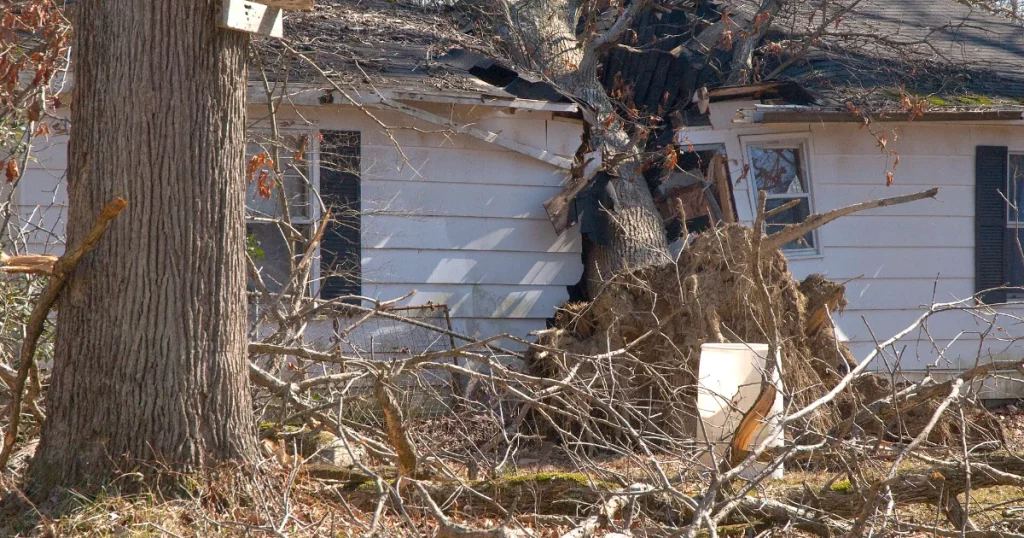
An “act of God” tree loss is damage caused by a natural event no one could control or reasonably prevent — a healthy tree brought down by a storm, high wind, lightning, or heavy ice. When a tree fails that way, the damage is normally covered by the policy of whoever owns the damaged property, not by the tree owner. The phrase matters less as a coverage rule than as a liability rule: it is the reason your neighbor usually does not have to pay when their tree lands on your roof.
The phrase also gets used loosely, and that is where homeowners get hurt. Adjusters say “act of God” when they mean “nobody was negligent.” Tree owners say it when they hope it ends the conversation. Neither use decides whether your claim gets paid. This guide explains what the term actually does in a tree-damage file, when it protects a tree owner, when it stops protecting them, and what to do if an insurer uses it to deny you.
What “act of God” actually means in tree cases
An act of God (courts more often say force majeure or “unavoidable casualty”) is an event caused solely by natural forces, without human negligence contributing to it. Applied to trees, three things must generally be true:
- The trigger was natural — wind, lightning, ice, saturated ground, an earthquake.
- The event was severe enough that a reasonable owner would not have guarded against it.
- The tree’s own condition did not contribute meaningfully to the failure.
That third element is the one that decides most disputes. A hurricane that snaps a sound, well-maintained oak is an act of God. The same hurricane finishing off a hollow, dead trunk the owner had been warned about for two years is not — the storm was just the last push.
It is a liability term, not a coverage term
Standard homeowners policies do not contain an exclusion called “acts of God.” Wind, hail, lightning, and falling objects are named covered perils in most HO-3 forms. So when an adjuster says “that was an act of God,” they are almost never saying your policy will not pay. They are saying the other party’s liability policy will not pay, because liability coverage responds to negligence and there was none.
This distinction is the single most useful thing to understand. It reframes the question from “who was at fault?” to “whose policy is this?” — and the answer to the second question is usually simpler.
Where the damage lands is what matters
| Scenario | Who normally pays | Why |
|---|---|---|
| Neighbor’s healthy tree falls on your house in a storm | Your homeowners policy | No negligence by the tree owner; wind is a covered peril on your policy |
| Your own healthy tree falls on your house | Your homeowners policy | Covered peril; deductible applies |
| Neighbor’s known-dead tree falls on your house | Neighbor’s liability coverage (potentially) | Negligence — they were on notice and failed to act |
| Tree falls and hits nothing but your lawn | Often nobody | Removal-only losses are usually capped or excluded |
| Neighbor’s healthy tree falls on your car | Your auto comprehensive coverage | Falling objects fall under comprehensive, not the home policy |
If you are working through a specific version of this, our guide on who is liable when a neighbor’s tree falls on your house walks through the fault analysis in more detail.
When “act of God” genuinely protects the tree owner
Courts have been consistent on the underlying principle for a long time: a landowner is not an insurer of their trees. They owe a duty of reasonable care, not a guarantee that nothing will ever fall. Where a tree owner exercised reasonable care and a natural event still brought the tree down, the loss stays where it falls.
What “reasonable care” looks like
The standard is not perfection. In most jurisdictions a residential owner satisfies it by doing roughly what an attentive homeowner would do:
- Noticing obvious problems visible from the ground — large dead limbs, a sudden lean, fungal conks at the base, a split trunk.
- Acting on those problems within a reasonable time.
- Responding when someone — a neighbor, a city inspector, an arborist — points out a defect.
Notably, most courts do not require a suburban homeowner to hire an arborist to inspect every tree on a schedule. Rural and heavily wooded parcels are often held to an even lighter standard, because inspecting every tree would be impractical. Commercial owners and municipalities, by contrast, are frequently held to a higher, more systematic duty. A basic tree risk assessment is the usual way an owner documents that they met the standard.
Storm severity is evidence, not a magic word
The stronger the storm, the more persuasive the act-of-God defense — because a genuinely extreme event explains the failure without needing a defective tree. If sound, healthy trees across the whole neighborhood came down in the same event, that is powerful evidence the failure was about the weather rather than about this particular tree. Conversely, if one tree failed on a merely breezy day while every tree around it stood, that fact alone invites a hard look at the tree’s condition.
When the defense fails: notice and negligence
The act-of-God defense collapses when the tree owner knew, or should have known, the tree was hazardous. This is the doctrine of notice, and it is the hinge on which nearly every contested tree-damage case turns.
Actual notice vs. constructive notice
| Type of notice | What it means | Typical proof |
|---|---|---|
| Actual notice | The owner was directly told | Certified letter, text messages, email, a city code-enforcement notice, an arborist report given to them |
| Constructive notice | The defect was so obvious a reasonable owner would have seen it | Photos of a bare, leafless tree in mid-summer; a visible cavity or heaving root plate; long-standing lean |
Constructive notice is why a tree owner cannot win simply by saying “I never looked.” A tree that has been visibly dead for three growing seasons puts its owner on notice whether or not anyone ever mentioned it.
Creating the record before anything falls
If you are worried about a neighbor’s tree today, the most valuable thing you can do is create a dated, provable record — because it converts a future “act of God” into a future negligence claim. In practice:
- Photograph the defect, with something in frame that dates the image.
- Raise it in person first; most disputes end here.
- If that fails, send a dated written notice by certified mail describing the specific tree and the specific defect. Vague letters (“your trees worry me”) do far less work than specific ones (“the 40-foot maple approximately 15 feet north of our shared fence has no foliage and a large cavity at its base”).
- Attach or follow up with an arborist’s report if you can get one. Once a professional assessment is in your neighbor’s hands, “I didn’t know” stops being available to them.
- Ask your municipality’s code-enforcement or urban-forestry office to inspect. A municipal notice is excellent evidence.
Our guide to dealing with a neighbor’s dangerous tree covers the escalation path in more depth.
How insurers apply it to your own claim
On a first-party claim — your policy, your damage — the practical questions are narrower than the legal doctrine suggests.
What is usually covered
| Loss | Typical treatment under a standard HO-3 |
|---|---|
| Tree strikes a covered structure (house, garage, fence) | Repair of the structure covered, subject to deductible |
| Removing the tree off the structure | Generally covered as part of the loss |
| Removing a tree that hit nothing | Often excluded, or capped at a small sublimit (commonly a few hundred dollars, sometimes per-tree) |
| Replacing the tree itself | Limited landscaping coverage, often a small percentage of dwelling coverage with a per-tree cap |
| Damage to a vehicle | Auto comprehensive, not homeowners |
| Additional living expenses if the home is unlivable | Usually covered |
The removal-only gap surprises people every storm season. A large tree can fall harmlessly into open yard and still cost several thousand dollars to cut up and haul away — and that is frequently the homeowner’s own expense. Check your declarations page for “debris removal” and “trees, shrubs and other plants” sublimits before you need them. See what homeowners insurance covers when a tree falls on a house for the full breakdown.
Why an insurer might actually deny
When a first-party tree claim is denied, the reason is usually one of these — and none of them is really “act of God”:
- Pre-existing condition / neglect. The insurer argues the tree was already dead or diseased and the loss was maintenance, not a sudden accident.
- Flood or earth-movement exclusion. If the tree came down because saturated ground moved, the insurer may route the claim into an excluded peril.
- No covered structure was struck. The removal-only gap described above.
- Deductible exceeds the loss. Common with wind/hail percentage deductibles in storm-prone states.
- Late reporting. Policies require prompt notice; long delays give insurers an argument.
What to do if you are told “that was an act of God”
Treat it as an opening position, not a verdict. Work through this sequence:
- Get the denial in writing, with the policy language cited. An adjuster who cannot point to a specific provision is giving you an opinion, not a coverage decision.
- Identify which policy you are actually arguing about. If the answer is “the neighbor’s liability policy,” you may be in the right doctrine but the wrong place — your own policy may pay regardless.
- Attack the negligence element, not the weather. You will not win by arguing the storm was mild. You win by showing the tree was defective and the owner knew. Gather pre-loss photos, prior correspondence, neighbor statements, and municipal records.
- Get a post-failure arborist report. A qualified arborist can often read decay, root-plate failure, or prior dieback from the fallen trunk and stump and put a date range on it. This is the strongest single piece of evidence in most cases.
- Appeal internally, then escalate. Most carriers have a formal reconsideration process. If that fails, your state department of insurance accepts complaints, and many policies allow appraisal for disputes about the amount of loss.
- Consider small claims. For losses under your state’s small-claims ceiling — commonly $5,000 to $12,500 — you can pursue a negligent tree owner without hiring a lawyer. See using small claims court for tree damage.
The evidence that actually moves these files
| Evidence | What it proves | Strength |
|---|---|---|
| Dated pre-loss photos of the defect | The condition existed and was visible | Very high |
| Certified-mail notice with receipt | Actual notice to the owner | Very high |
| Arborist report (before or after) | The defect was professionally identifiable | Very high |
| Municipal inspection or citation | Independent confirmation plus notice | High |
| Local weather data for the date | Whether the event was truly extreme | Moderate |
| Neighbor witness statements | How long the defect was apparent | Moderate |
| Photos of the stump and root plate | Internal decay vs. sound wood | High |
Reducing your exposure before the next storm
Both roles — tree owner and downhill neighbor — have work to do, and it is mostly cheap.
If you own the trees
Walk your property after every significant storm and once each spring, and look for the classic warning signs: no leaves when neighboring trees have leafed out, mushrooms or conks at the base, a fresh lean with cracked or lifted soil on the opposite side, deep vertical trunk cracks, and large dead limbs in the canopy. Document what you find and what you did about it. A folder of dated photos and receipts is what turns a lawsuit into an act of God.
If you live next to the trees
Photograph anything concerning now, while it is standing. Confirm your own coverage limits — particularly debris removal and any wind/hail percentage deductible. And remember your self-help right: in nearly every state you may trim branches and roots back to the property line at your own expense, from your own property, without permission — but you may not enter your neighbor’s land, and you may not damage or kill the tree. Overstepping can expose you to double or treble damages.
Frequently asked questions
Does homeowners insurance cover an act of God?
Yes, in most cases. Standard policies do not exclude “acts of God” as a category — they cover named perils including wind, lightning, hail, and falling objects, which is what most act-of-God tree losses actually are. Flood and earthquake are the major natural events typically excluded and sold separately.
My neighbor says the storm was an act of God, so they owe nothing. Are they right?
They are right only if the tree was in reasonably sound condition and they had no notice of a defect. If the tree was visibly dead, decayed, or leaning — and especially if anyone had told them so — the defense fails and their liability coverage may respond.
Who pays my deductible when a neighbor’s tree hits my house?
You do, if the claim goes through your own policy. Some insurers will subrogate against a negligent neighbor’s carrier and refund your deductible if they recover. Ask your adjuster directly whether they intend to subrogate.
Is a dead tree falling ever an act of God?
Rarely. Once a tree is dead, its failure is foreseeable, and foreseeability is exactly what the doctrine excludes. The owner’s best remaining argument is usually that the death was recent and not yet apparent.
Does filing a tree damage claim raise my rates?
It can, though weather-related claims are often treated more leniently than liability claims. Frequency matters more than any single claim. See our discussion of whether tree damage claims raise insurance rates.
How long do I have to bring a claim against a negligent tree owner?
Statutes of limitation for property damage commonly run two to six years depending on the state, measured from the date of damage. Insurance policies impose much shorter notice deadlines — often prompt notice plus a one- or two-year suit limitation. Do not wait.
What if the tree was on city property?
Claims against municipalities follow special rules, including short notice-of-claim windows that can be as brief as 30 to 180 days, and governmental immunity defenses. Move quickly and check your city’s claims procedure.
Disclaimer: This article is general information about tree and property law, not legal or insurance advice. Tree liability, notice standards, statutes of limitation, and insurance regulation vary significantly by state and by policy. Read your own policy and consult a licensed attorney or insurance professional in your state before acting on a specific claim.
