

Insurance Claim for a Fallen Tree: How to File & Get Paid
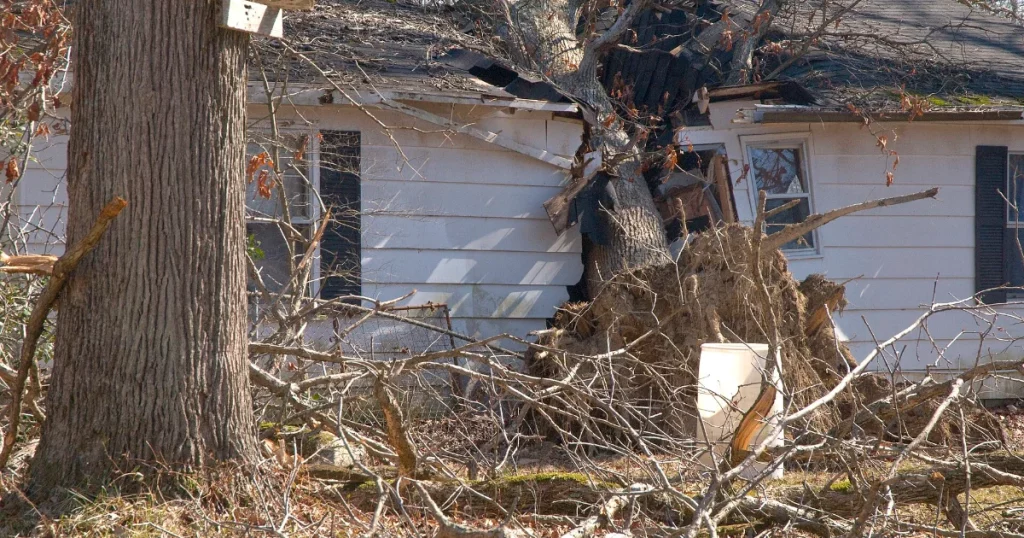
To file an insurance claim for a fallen tree, make sure everyone is safe, document the damage with photos and video, make temporary repairs to prevent further loss, then contact your homeowners insurer to open the claim. An adjuster inspects the damage, and your policy pays to repair the insured structure and remove the tree—usually minus your deductible.
Whether the claim is paid at all depends on what the tree hit and why it fell. A tree that damages your house, garage, or fence is typically covered; a healthy tree that falls in an open yard and hits nothing usually is not. Below is the full process, what your policy pays, whose insurance is responsible, and the mistakes that get claims denied. This is general information, not insurance or legal advice—coverage varies by policy and state.
Does homeowners insurance cover a fallen tree?
Homeowners insurance generally covers a fallen tree when it damages a structure on your property or blocks access to it. Coverage usually applies when the tree falls due to a covered peril such as wind, lightning, hail, or the weight of ice and snow. If a tree simply falls in your yard without hitting anything, most policies won’t pay to remove it.
| Situation | Typically covered? |
|---|---|
| Tree hits your house, roof, or attached structure | Yes |
| Tree hits a detached garage, shed, or fence | Yes (other-structures coverage) |
| Tree falls and blocks your driveway or a wheelchair ramp | Often yes |
| Healthy tree falls in the yard, hits nothing | Usually no |
| Tree was clearly dead or neglected before it fell | Often denied (negligence) |
| Tree fell due to flood or earthquake | No (separate policy needed) |
For a deeper look at coverage rules, see our guides on whether homeowners insurance covers tree damage and tree removal.
How to file an insurance claim for a fallen tree
Filing promptly and thoroughly is the single best way to get a fair payout. Follow these steps in order:
- Ensure safety first. Move everyone away from the damaged area and watch for downed power lines. Shut off gas or electricity if lines are compromised, and call your utility for any wires.
- Document the damage. Photograph and video everything—inside and outside—before you move anything. Capture the tree, the structural damage, and any damaged belongings.
- Make temporary repairs. Tarp the roof, board broken windows, and stop water intrusion. Insurers expect you to prevent further damage, and these costs are usually reimbursable.
- Contact your insurer quickly. Call your agent or the claims line as soon as possible to open the claim and get a claim number.
- Meet the adjuster. Your insurer sends an adjuster to inspect. Walk them through the damage and share your photos and notes.
- Gather repair quotes. Get written estimates from licensed contractors for the structure and for tree removal.
- Save every receipt. Keep receipts for tarps, emergency repairs, and lodging if you had to relocate—these support reimbursement.
Documentation checklist
- Dated photos and video of all damage
- A written inventory of damaged belongings with rough values
- Receipts for temporary repairs and emergency expenses
- Contractor estimates for repair and removal
- Your policy number and any prior tree-maintenance records
What a fallen-tree claim pays for
A standard homeowners policy addresses a fallen tree through several coverage parts. Tree removal is usually capped, so it helps to know the limits before you file.
| Coverage part | What it pays | Typical limit |
|---|---|---|
| Dwelling | Repairs to your house and attached structures | Up to your dwelling limit |
| Other structures | Detached garage, shed, fence | Often ~10% of dwelling limit |
| Personal property | Belongings damaged by the tree | Up to contents limit |
| Debris/tree removal | Removing the fallen tree from an insured structure | Commonly $500–$1,000 |
| Loss of use | Extra living costs if the home is uninhabitable | Policy-specific |
Note that you pay your deductible before the policy pays, so a small claim can be worth less than the deductible. Compare the repair cost against your deductible before filing.
Whose insurance pays: yours or your neighbor’s?
A common surprise: the insurance that pays is usually the owner of the property the tree landed on, not the owner of the tree. If your neighbor’s tree falls on your house, you typically file with your own insurer, who may later seek reimbursement (subrogation) from the neighbor’s insurer if negligence is shown.
| Scenario | Whose policy usually responds |
|---|---|
| Your tree falls on your house | Your policy |
| Neighbor’s tree falls on your house (healthy tree, storm) | Your policy |
| Neighbor’s clearly dead tree falls on your house | Your policy first; may pursue neighbor for negligence |
| Your tree falls on neighbor’s house | Neighbor’s policy (they file) |
For more on liability between neighbors, read who is responsible for removing a fallen tree and what to do when a neighbor’s tree damages your property.
Why fallen-tree claims get denied
Understanding the common denial reasons helps you avoid them:
- Negligence. If the tree was visibly dead, diseased, or reported as hazardous and you didn’t act, the insurer may deny the claim.
- No structure damaged. Removing a tree that hit nothing is generally not covered.
- Excluded perils. Damage from flooding or earthquakes needs separate coverage.
- Maintenance issues. Rot, pest damage, and long-term neglect are treated as preventable, not sudden.
- Late filing or thin documentation. Waiting too long or lacking photos weakens the claim.
Keeping trees maintained and documenting their condition is the best defense. If you were warned about a neighbor’s hazardous tree, see how to force a neighbor to remove a dangerous tree before it falls.
Tips to strengthen your claim
- File as soon as it’s safe; prompt claims are viewed more favorably.
- Don’t dispose of the tree or damaged items until the adjuster has seen them.
- Keep a written log of every call, adjuster visit, and expense.
- Get independent repair estimates so you can question a low offer.
- For large or disputed losses, consider a licensed public adjuster, and review your state insurance department’s consumer resources.
Frequently asked questions
Will filing a fallen-tree claim raise my premium?
It can. A single weather-related claim may have little effect, but multiple claims can raise premiums. If the repair is close to your deductible, paying out of pocket may be cheaper long term.
Does insurance pay to remove a tree that fell in my yard?
Usually only if it hit an insured structure or blocks a driveway or accessibility ramp. A tree that falls and damages nothing is typically the homeowner’s cost to remove.
How long do I have to file a fallen-tree claim?
Policies set a deadline, and many require “prompt” notice. Report the loss within days, not weeks, and check your policy for the exact time limit in your state.
What if my insurer’s tree-removal limit doesn’t cover the cost?
You pay the difference. Removal caps are often $500–$1,000, so get quotes early and ask whether higher debris-removal limits are available at renewal.
Damage limited to an outbuilding? See our specific guide to a tree that fell on a shed.
Disclaimer: This article is general information, not insurance or legal advice. Coverage, limits, and deadlines vary by policy, insurer, and state. Read your policy and consult your insurer or a licensed professional for your specific claim.
If the same tree also brought down the wires, read who is responsible when a tree falls on a power line before you file.
