

Who Is Liable If a Tree Falls on a Car?
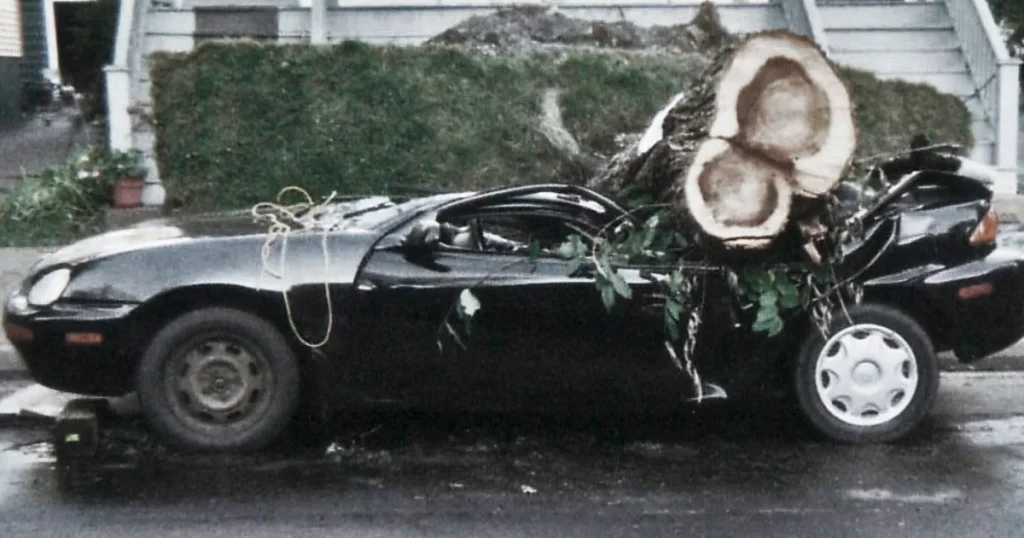
If a tree falls on your car, your own comprehensive auto insurance usually pays for the damage, minus your deductible, no matter whose tree it was. The owner of the tree only becomes liable if you can show they were negligent, meaning they knew or should have known the tree was hazardous and failed to deal with it. A healthy tree that falls in a storm is generally treated as an act of nature, and no one is at fault.
When the tree stands in the public right-of-way, see who is responsible for city trees to identify the owner.
Related: does homeowners insurance cover tree damage?
That single distinction, ordinary bad luck versus provable negligence, decides who pays after a tree crushes a vehicle. This guide walks through which insurance applies, when a neighbor or city can be held responsible, and the exact steps and evidence you need.
This article is general information, not legal or insurance advice. Liability rules and policy terms vary by state and insurer. Check your policy and, for a specific claim, consult your insurer or a local attorney.
Who pays if a tree falls on your car?
In most cases, you file with your own auto insurer and your comprehensive coverage pays, regardless of whether the tree was yours, a neighbor’s, or the city’s. Comprehensive covers falling objects, including trees and limbs. The tree’s owner pays only when negligence is proven, in which case their homeowners or general liability insurance may cover your loss. If the tree was healthy and fell in a storm, courts and insurers usually treat it as an act of God with no one at fault.
Which auto coverage actually applies
The type of auto insurance you carry is what determines whether you are covered. This is the single most common point of confusion after a tree falls on a car.
| Coverage type | Does it cover a tree falling on your car? |
|---|---|
| Comprehensive (other-than-collision) | Yes. This is the coverage that pays for falling trees and limbs, minus your deductible. |
| Collision | No. Collision covers impacts with another vehicle or object you hit, not objects that fall on you. |
| Liability only | No. Liability pays for damage you cause to others, not damage to your own car. |
If you carry liability only and the tree owner was not negligent, you may have to pay for repairs yourself. This is why comprehensive coverage matters in tree-heavy or storm-prone areas.
When the tree owner is liable
A neighbor, landlord, or city can be held responsible when their negligence caused the fall. Negligence usually means all of the following were true:
- The tree was visibly hazardous, for example dead, dying, diseased, hollow, or clearly leaning.
- The owner knew or reasonably should have known about the danger.
- The owner failed to act within a reasonable time, such as ignoring written warnings or an arborist’s report.
- That failure caused the tree to fall and damage your car.
When those elements are met, the owner’s homeowners insurance may pay, and your insurer may pursue reimbursement from them. This is closely related to what you can do about a neighbor’s dangerous tree before it ever falls.
Act of God versus negligence
Insurers and courts draw a sharp line between an unforeseeable natural event and a known, ignored hazard.
| Scenario | Usual outcome |
|---|---|
| Healthy tree falls in a storm | Act of God; your comprehensive coverage pays, owner not liable |
| Dead or rotting tree falls in calm weather | Possible negligence; owner may be liable |
| Owner warned in writing, tree later falls | Strong negligence case against owner |
| City tree with documented decay falls | Municipality may be liable, subject to claim rules |
Steps to take if a neighbor’s tree falls on your car
Acting methodically protects both your claim and your relationship with your neighbor.
- Document everything. Photograph the car, the tree, and the trunk’s condition (look for rot or hollowing) before anything is moved.
- Do not drive a damaged vehicle if safety is in doubt.
- File with your own auto insurer under comprehensive coverage. They handle repairs first, then sort out responsibility.
- Notify the tree’s owner and ask for their homeowners insurance details if you believe the tree was neglected.
- Gather evidence of prior warnings, such as texts, emails, or certified letters showing the owner knew the tree was dangerous.
- Let subrogation work. If negligence is clear, your insurer may recover your deductible from the owner’s insurer.
If the same tree also hit your home or roof, see what to do when a neighbor’s tree falls on your house and our guide to filing a tree damage insurance claim.
How to prove the owner was negligent
Negligence claims rise or fall on documentation. The strongest evidence includes:
- Certified letters or written warnings you sent about the tree’s condition, with dates.
- Photographs over time showing visible decay, lean, or dead limbs.
- An arborist’s report stating the tree was hazardous and the failure was foreseeable.
- Witness statements from neighbors who also raised concerns.
Without proof that the owner knew and ignored the risk, insurers will almost always classify the event as an act of God and route the claim back to your own comprehensive coverage. The same evidence standard governs whether homeowners insurance covers a tree falling on a house.
Special cases: city trees, rentals, and parking lots
A city or street tree fell on your car
When a municipally owned tree causes damage, the city may be liable only if it had notice of the defect and failed to act. Government claims usually have short deadlines and special notice requirements, so act quickly.
You rent and a tree on the property fell on your car
A landlord can be liable if they neglected a known hazardous tree on the rental property. Otherwise your own comprehensive coverage applies.
A tree fell on your car in a business parking lot
The property owner is liable only if they failed to maintain a tree they knew was dangerous. A storm-felled healthy tree typically is not their responsibility.
Frequently asked questions
Will my insurance go up if a tree falls on my car?
A comprehensive claim for a falling tree is usually considered not-at-fault, so rate impact is often minimal, but this varies by insurer and state.
Does my neighbor’s homeowners insurance pay for my car?
Only if you can prove the tree was neglected and the owner knew it was dangerous. For a healthy tree felled by weather, your own comprehensive coverage pays.
What if I only have liability auto insurance?
Liability does not cover damage to your own vehicle. Unless you prove the tree owner was negligent, you may have to pay for repairs out of pocket.
Is a tree falling on a car considered an act of God?
Usually yes, if the tree was healthy and fell during a storm. A dead or visibly hazardous tree that falls can instead point to owner negligence.
Who removes the fallen tree from my car?
Responsibility for cleanup depends on where the tree stood and who owns it. See our guide on who is responsible for fallen tree removal for details.
