

Boundary Tree Law: Trees on the Property Line
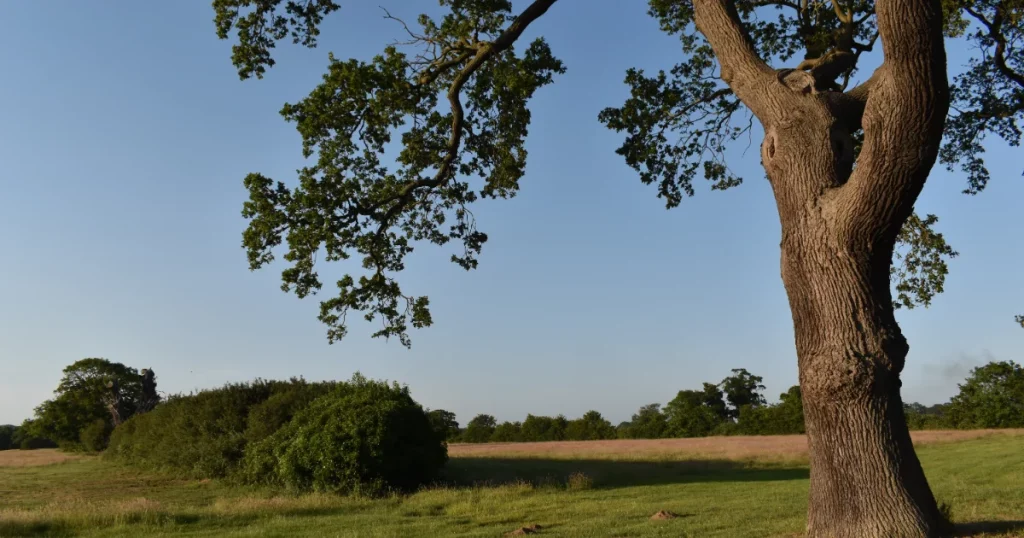
Under boundary tree law, a tree whose trunk straddles the line between two properties is a “boundary tree” that both neighbors own together as tenants in common. Neither owner may cut down or seriously damage a boundary tree without the other’s consent, and both generally share responsibility for its care and any hazard it creates. Where the trunk sits entirely on one side of the line, that owner owns the tree — even if the branches and roots reach into the neighbor’s yard.
Related boundary issue: what the law says when bamboo spreads across the property line.
A tall row of boundary trees planted out of malice can even qualify as a spite fence under many state laws.
Ownership matters here: before you cut down your own tree, confirm the trunk is entirely on your side of the line.
That sounds simple, but boundary trees cause some of the most common — and bitterest — neighbor disputes. Who can trim the branches? Who pays if it falls? What happens if one neighbor cuts it down? This guide explains who owns a tree on the property line, what each neighbor can and cannot do, how overhanging branches and roots are treated, who is responsible for costs and damage, and how the rules differ from state to state. Laws vary, so treat this as a general framework rather than the final word in your jurisdiction.
What is a boundary tree?
A boundary tree (also called a line tree or division-line tree) is a tree whose trunk grows on the boundary between two parcels, so part of the trunk sits on each owner’s land. The legal test almost always turns on the location of the trunk at ground level, not the branches or roots. If the trunk crosses the line, the tree is shared; if the whole trunk is on one side, the tree belongs to that property even when limbs and roots extend next door.
Trees deliberately planted on the line as a marker, or that have grown together over decades into the boundary, are treated the same way: as jointly owned property of both neighbors.
Who owns a tree on the property line?
Ownership follows the trunk. When the trunk is divided by the boundary, courts in most states hold that the neighbors own the tree as tenants in common — each has an interest in the whole tree, and neither can destroy it unilaterally. The table below summarizes the usual outcomes.
| Where the trunk sits | Who owns the tree | Key consequence |
|---|---|---|
| Entirely on one owner’s land | That owner alone | Neighbor may trim intruding branches/roots to the line only |
| Straddling the boundary line | Both owners jointly (tenants in common) | Neither may remove or seriously harm it without consent |
| Planted on the line as a marker | Both owners jointly | Shared care and shared protection under the law |
Because the line itself is decisive, a current survey matters. If you are unsure where your boundary runs, a licensed surveyor can locate the trunk relative to the legal line before any dispute escalates.
Can you cut down or remove a boundary tree?
Generally, no — not on your own. Because a boundary tree is jointly owned, one neighbor cannot remove it, top it, or damage it in a way that kills or devalues it without the other owner’s agreement. Doing so can expose the cutter to serious liability.
Many states impose double or triple (treble) damages for wrongfully cutting or destroying another person’s tree, and a co-owned boundary tree is squarely protected. If a neighbor removes a shared tree without permission, the other owner may recover the tree’s value — sometimes multiplied by statute. Our guides on treble damages for tree cutting and what to do when a neighbor cut down your tree without permission explain the remedies, and recovery usually starts with a professional tree appraisal to establish the tree’s value.
The practical takeaway: if you want a boundary tree removed, get the co-owner’s written consent first. If the tree is dead, diseased, or dangerous, document the hazard and try to reach a shared agreement before acting.
Overhanging branches and encroaching roots
What about a tree owned entirely by your neighbor whose branches or roots cross onto your land? Most states follow the self-help rule: you may trim branches and roots back to the property line at your own expense, but with important limits.
| You generally may | You generally may not |
|---|---|
| Trim branches back to the boundary line | Cross onto the neighbor’s land without permission |
| Cut encroaching roots on your side | Cut so much that you kill or destabilize the tree |
| Keep or return the trimmings (varies locally) | Enter and top or remove the whole tree |
Trim carefully: if your cutting kills the tree or makes it hazardous, you can be held liable even though you were working on your own side. For the full rules on who may cut what, see our guide on who is responsible for cutting overhanging tree branches. Encroaching roots that buckle pavement raise related issues — our article on tree roots lifting a sidewalk covers responsibility and repair.
Shared responsibility: maintenance, costs, and damage
Co-owners of a boundary tree share both the benefits and the burdens. In principle, the neighbors are jointly responsible for reasonable maintenance, and the cost of care or removal of a shared tree is typically split — though the exact allocation often comes down to agreement or, failing that, the courts.
Liability for damage usually turns on negligence. If a healthy boundary tree falls in a storm and damages property, that is often treated as an act of nature, and each owner’s own insurance generally handles damage to their own property. But if the tree was visibly dead, diseased, or hazardous and the owners failed to act after notice, an injured party may have a negligence claim. Documenting a known hazard in writing — and sharing that notice with the co-owner — is the single most important step for protecting yourself.
How boundary tree law varies by state
The trunk-location rule and joint-ownership principle are widely followed, but the details — damage multipliers, notice requirements, and how disputes are resolved — differ. The examples below illustrate the common approach; they are not a substitute for your state’s statutes and case law.
| State (example) | General approach to boundary trees |
|---|---|
| Illinois | Trunk location controls; a line tree is jointly owned and neither owner may remove it without consent |
| Colorado | A trunk on the line makes the tree a jointly owned boundary tree shared by both neighbors |
| New Hampshire | When a tree sits on the line, each owner jointly owns the entire tree |
| California | Line trees are common property of the adjoining owners; consent is needed to remove, and wrongful cutting can bring multiplied damages |
For a plain-language national overview, the legal publisher Nolo maintains a helpful summary of tree disputes with neighbors. Always confirm the specifics with your state statutes or a local attorney.
How to handle a boundary tree dispute
Most boundary tree conflicts are better solved at the fence line than in court. A practical sequence:
- Confirm the boundary. Get a survey so everyone knows where the trunk sits relative to the legal line.
- Talk first, in good faith. Many disputes dissolve once both sides understand they jointly own the tree.
- Put agreements in writing. Record who pays for trimming, removal, or hazard work, and keep copies.
- Bring in a neutral expert. A certified arborist can assess health and hazard objectively; an appraiser can value the tree.
- Use mediation before litigation. A mediator is faster and cheaper than a lawsuit and preserves the relationship.
If a neighbor has already cut or destroyed a shared tree, document the damage, photograph the stump and trunk location, and obtain an appraisal before pursuing a claim.
For a tree that clearly belongs to one owner, see our guide on what your neighbor can and cannot cut on your tree.
Frequently asked questions
Who owns a tree on the property line between two houses?
If the trunk straddles the boundary, both neighbors own it jointly as tenants in common, and neither can remove it without the other’s consent. If the entire trunk is on one side, that owner owns the tree.
Can my neighbor cut down a tree on the boundary line?
Not without your consent. A boundary tree is co-owned, so cutting it down unilaterally can make your neighbor liable for the tree’s value — potentially doubled or tripled under some state statutes.
Can I trim my neighbor’s tree that hangs over my yard?
Usually yes, back to the property line and at your own expense, but you may not enter their land or cut so much that you harm or kill the tree. Excessive trimming can make you liable.
Who pays to remove a dangerous boundary tree?
Co-owners generally share the cost of caring for or removing a jointly owned tree. If owners disagree, the allocation may be decided by agreement or by a court, and liability for damage typically depends on whether a known hazard was ignored.
This article is general legal information, not legal advice. Boundary tree law, damage multipliers, and dispute procedures vary by state and locality. For a specific situation, consult an attorney licensed in your state and a certified arborist.
Long-standing tree lines raise a related worry: whether decades of use can move the boundary itself. We answer that in adverse possession and trees.
Planning to sell? Boundary-tree conflicts are often material facts. See our guide to disclosing a tree dispute when selling.
Co-ownership also extends to what a shared tree produces. Our guide to fruit ownership on a neighbor’s tree explains how the crop is divided.
